As of this writing, the IA Summit in New Orleans is drawing near, and I am to present, at the IA Institute annual general meeting, the work I have done and continue to perform around the organization's website.
Those of you who aren't acquainted with my style would do well to note that I rarely work in a straight line—at least not until I'm confident that said line is indeed straight. I've been working with the Web for over half my life and if there's one thing that makes an endeavour go slower is an attempt to make it go faster. That, and at best I only have a few hours a week I can part with.
Starting shortly after my election and continuing sporadically through to the present, I have assembled a collection of artifacts around the Institute and its Web presence. At the AGM, I will explain how this work will accelerate and how the community can get involved.
Les Voilà
- Position Statement for My Nomination to the IAI Board
- Might as well begin with my position statement. This, presumably, is what got me elected. In retrospect it's a bit frou-frou, but I still agree with it. True to form, I only get to the point in the last paragraph, where I state my interest in setting information architecture apart from similar nascent disciplines while at the same time weaving it in with them. This objective has been in the back of my mind throughout the entire process.
- It's Only Fitting that the Cobbler's Children Get Shoes
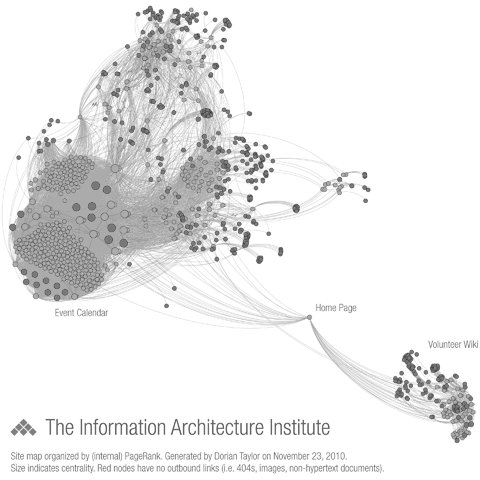 This was my first crack at the topology of the IAI website. My strategy was—and still is—to shape the project of creating a new site into something attainable through the part-time effort of a loosely-knit group of volunteers. Here, this meant trying to get a look at the site's anatomy without having to take an exhaustive trawl through it.
- Characterizing the Information Architecture Institute
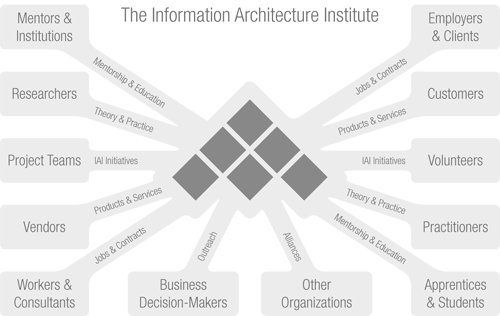 Rather fortuitously one afternoon, I came up with a conceptual model which we (the board) finalized at a retreat in Iceland. I still maintain that while it greatly simplifies the constituencies, there is an even simpler notion of the mediating versus the direct relationship.
- Content Robo-Inventory
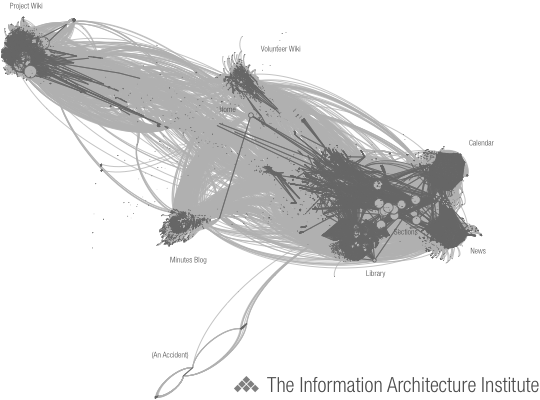 This is my second crack at the site's topology, which is considerably more dense than the first. That's because it turned out that my previous crawler had missed a wiki or two. We apparently have four of them.
- Visualizing Paths through the Web
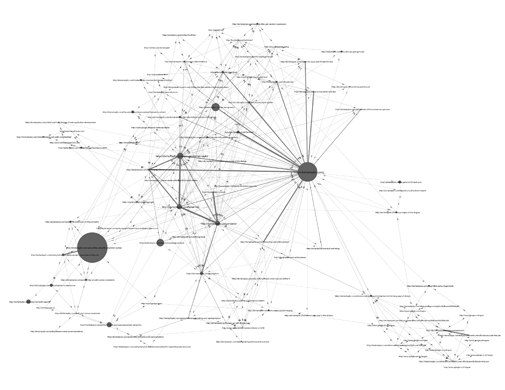 I also analyzed the site's access logs to see if there were patterns in the paths people took through it. Unsurprisingly, there were.
- 2-Up Content Audit
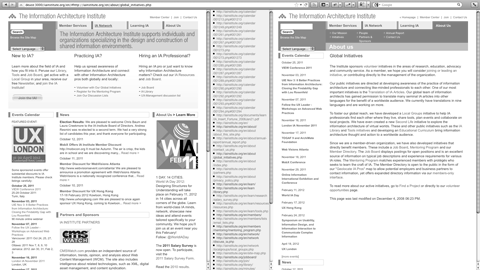 I expanded on this idea of common paths to consider narrative continuity across links. Too often when I follow a link, I find the tone, style, and even the content of a site to contradict itself. So I made a prototype of a tool to help counteract that.
- Shearing Layers Applied to the Web
- With this preliminary technical poking and prodding done, I wanted to collect my thoughts on why I had chosen to proceed this way. The answer has to do with sensitivity to time. Why I've put all this effort in precisely this way has to do with creating a perpetual artifact, rather than the latest iteration of something that gets thrown away every few years. I wrote this piece to guide my—and the rest of the board's—thinking.
In Addition
There's plenty of other stuff I've done but haven't written down yet:
- I have made a full census of the back-ends and services the IAI uses. There are 13 of them.
- I have created a third content-inventorying robocrawler. This one is special because it separates the main content of the pages, isolating their link structure from navigation, ancillary content and other repeating elements.
- I created an RDF vocabulary for content inventories which I plan to use to organize an audit (though I did this a pretty long time ago and only now really have the wherewithal to use it).
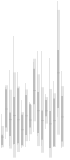 I devised a method for gathering descriptive statistics around word counts in HTML block-level elements. People don't have the same stamina for reading on the Web as they do on paper, and statistics like this are for putting that in check. I'm a minimalist when it comes to preliminary renderings of data but each discernible bar is a five-number summary of the words-per-block count per document, where one vertical pixel is a word. The mean and standard deviation are laid on top.
- Last but not least, I have created back-door code interfaces onto a number of the disparate databases the IAI uses, in order to facilitate migration and other further progress.
The rest is going to have to wait for the meeting!